
 Click to WhatsApp
 +91-9899993637
Robotic Prostate Surgery Cost in India
Affordable Treatment Packages at World Class Hospitals in India for International Patients.
Written by the SafeMedTrip Editorial Team. Medically reviewed by a board certified Urologist and Robotic Surgeon from our partner network. Last reviewed 19 September 2026. Next review due March 2027.
Get a Free Treatment Cost Estimate within 48 Hours
Doctor’s opinion and treatment cost estimate within 48 hours. No obligation, no service fee.
If you or a member of your family has been diagnosed with Prostate Cancer, you will want to know what the treatment is going to cost before you take any decision. Robotic Prostate Surgery packages at World Class Hospitals in India range from USD 7,500 to 9,000. Your hospital stay is normally only 2 to 3 days, and you should plan to remain in India for 10 to 14 days in all.
Every package is negotiated with the hospital for your own case, and you will be given a Treatment Cost Estimate in writing only after our doctors have gone through your reports. Send us your medical reports by Email or WhatsApp and we will get you an Expert Medical Opinion and a costed treatment plan within 48 hours, with No Obligation.
Robotic Prostate Surgery in India – Cost Guide, September 2026
The Robotic Prostate Surgery package prices in the table that follows are starting figures at SafeMedTrip network hospitals in India, current at September 2026. They are not quotations. Each hospital prices your case once it has seen how far the disease has progressed, and we negotiate the final figure on your behalf before you commit to anything.
| Procedure | Package From | Days in Hospital | Total Days in India |
|---|---|---|---|
| Robotic Radical Prostatectomy (da Vinci) | USD 7,500 to 9,000 | 2 to 3 | 10 to 14 |
| Open Radical Prostatectomy | Quoted for your case, lower than robotic | 5 to 7 | 14 to 21 |
| HoLEP Holmium Laser Surgery (for enlarged prostate, not cancer) | USD 3,250 onwards | 2 | 7 to 10 |
| Green Light PVP Laser Surgery (for enlarged prostate, not cancer) | USD 3,000 onwards | 2 | 7 to 10 |
| Return Air Ticket to India | From about USD 300 (Gulf) to USD 1,600 (North America), Economy | n/a | n/a |
Kindly note one important distinction. HoLEP and Green Light Laser treatments are for an enlarged prostate, which is a benign condition. They do not treat Prostate Cancer. If your biopsy has come back positive for cancer, the laser packages above do not apply to your case.
Robotic Prostate Surgery in India at a Glance
- Your treatment package ranges from USD 7,500 to 9,000. No hospital in our network will quote you a final figure before a doctor has read your reports, and neither will we.
- You will be in hospital for only 2 to 3 days. Plan for 10 to 14 days in India in all, because the catheter must come out and your pathology report must come back before you fly home.
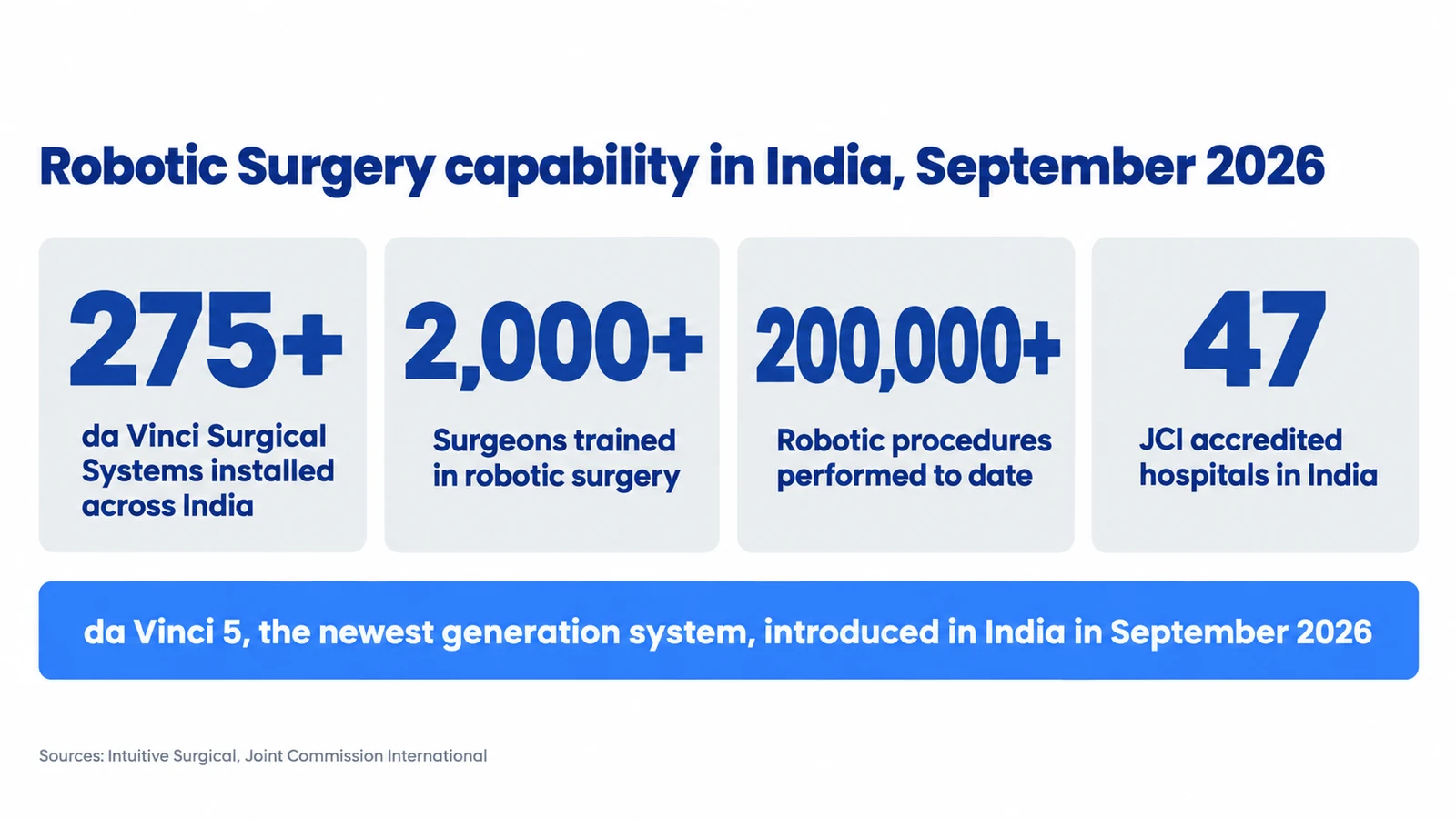
- What decides your result is the number of these operations your surgeon has personally performed, more than the country, the hospital or the method. India has over 2,000 surgeons trained on robotic systems and more than 200,000 robotic procedures performed.
- Your hospital is accredited by Joint Commission International or NABH, and both registers are public, so you can check it yourself before you travel.
- You may speak to the operating surgeon by video call before you commit, at a time arranged for your own time zone.
- You will pay the hospital directly after you arrive in India. No advance payment is required, and we charge you no service fee.
- Two family members can travel with you as attendants on a Medical Attendant Visa.
- Most nationalities apply for the Medical Visa online, for about USD 80. A few, Nigeria among them, must apply in person at an Indian mission. Your visa follows your passport, not where you live. Holders of United States, United Kingdom, Canadian, Australian, Gulf, Tanzanian and Zimbabwean passports apply online. Nigerian passport holders are not on India’s e-Visa list and must apply in person in Abuja or Lagos, where the fee is USD 585. Bangladeshi nationals pay no visa fee at all.
Is Treatment in India Safe? Check the Accreditation Yourself.
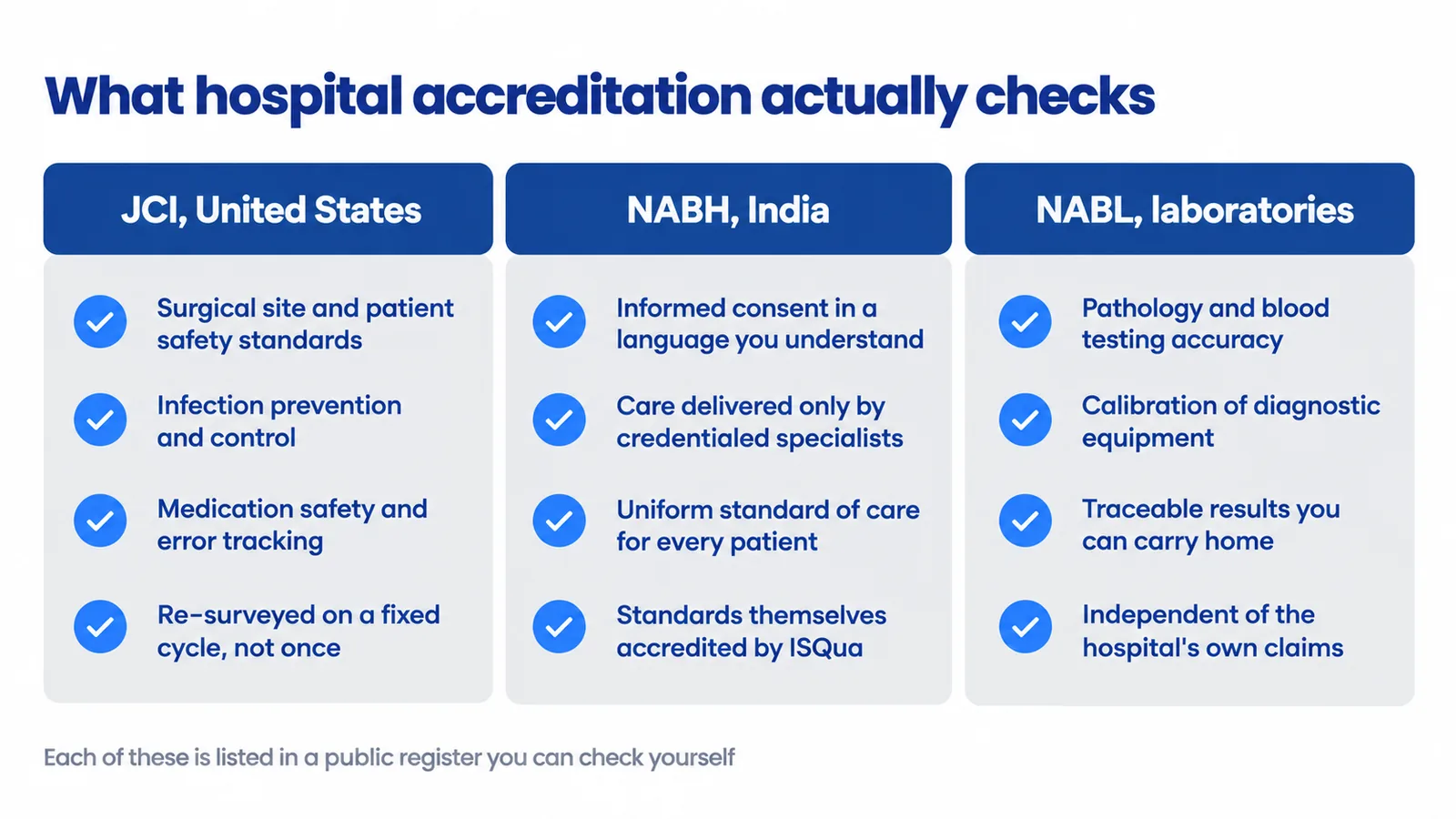
Every hospital we place a patient with is inspected against a published international standard. Each of those standards is listed in a public register you can search yourself, before you travel and without asking us. The three registers are linked below.

Joint Commission International
The American accreditation body, applying the same manual in India that it applies in the United States. It accredits 47 organisations in India and re-surveys on a fixed cycle. Search the register

NABH
A board of the Quality Council of India, set up in 2006, held by 1,299 hospitals. Its standards are themselves accredited by ISQua, the international body that accredits healthcare accreditation programmes. Search the register

NABL
The laboratory that reads your biopsy and your PSA is accredited separately from the hospital, so your results are traceable and you can carry them home to your own doctor. Search the register
What the USD 7,500 to 9,000 Robotic Prostate Surgery Package in India Includes
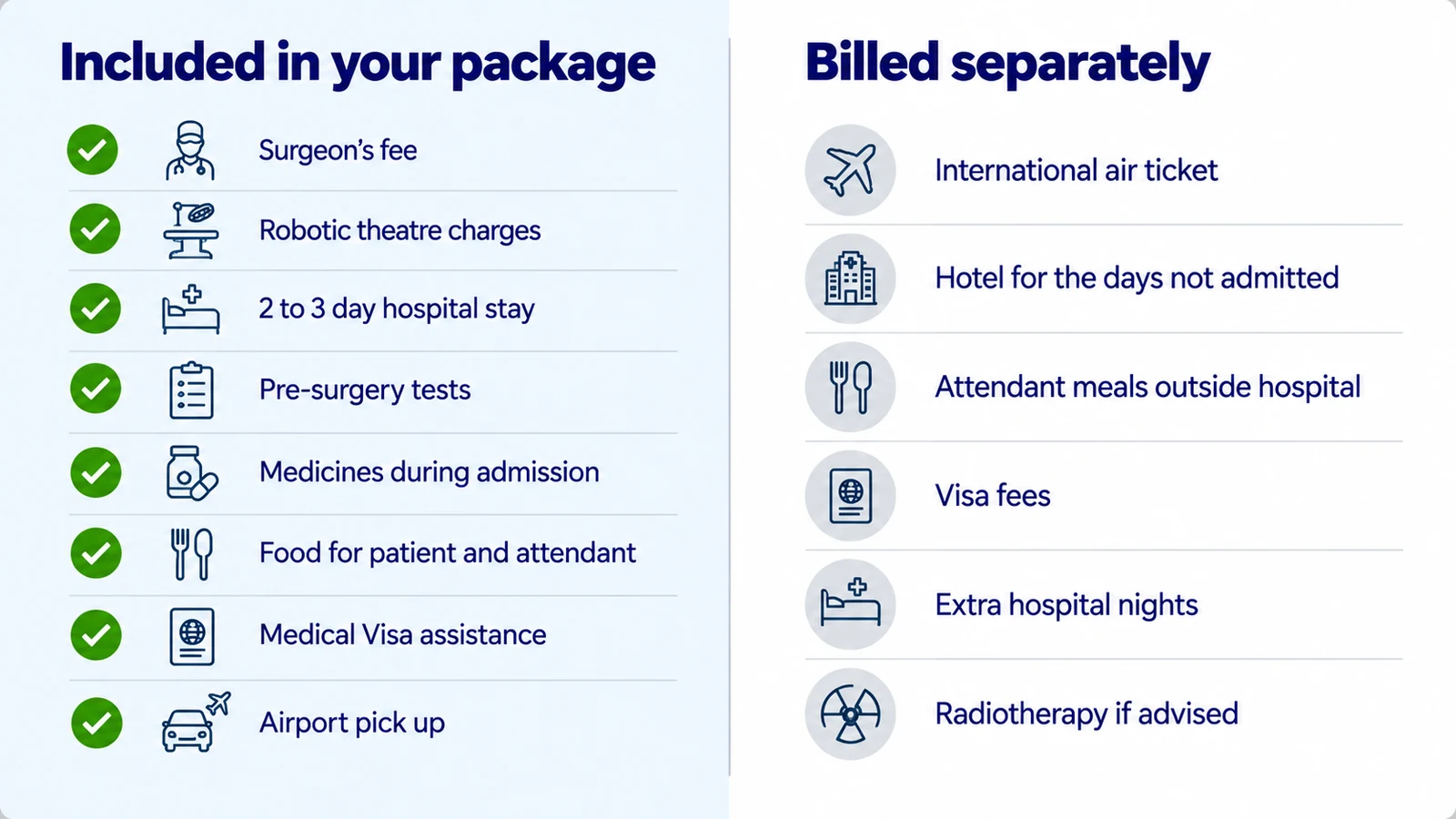
- Surgeon’s fee for the robotic procedure
- Robotic system and operation theatre charges
- Hospital stay of 2 to 3 days in a sharing room, where your attendant can also stay with you
- Pre-surgery medical tests and consultations
- Nursing care, medicines and consumables during your admission
- Food for you and your attendant while you are admitted
- Review of your reports by the operating surgeon before you travel
- A written treatment plan with the cost stated in advance
- Medical Visa assistance and the hospital invitation letter
- Airport pick up on arrival
- Histopathology report on the removed prostate
What the India Robotic Prostate Surgery Package Does Not Include
- Your international air ticket, which runs from about USD 300 return from the Gulf to about USD 1,600 return from North America, in economy
- Hotel or guest house for the days you are not admitted, normally 7 to 11 nights
- Meals for your attendant outside the hospital
- Visa fees, which you pay to the Indian mission in your own country
- Any additional night in hospital should your recovery need it
- Tests outside the standard pre-operative protocol
- Radiotherapy or hormone therapy, should your pathology report call for it
- Treatment of unrelated conditions found during your workup
Please budget realistically. On top of the package price, for you and one attendant across the two weeks, allow roughly USD 900 to 1,600 from the Gulf, USD 1,100 to 1,900 from South East Asia, USD 1,800 to 3,000 from Africa, and USD 2,200 to 3,500 from North America or Europe, covering return air tickets, accommodation and living costs.
What Decides the Cost of Your Treatment
Two JCI accredited hospitals in the same city will price the same operation differently. Theatre charges, room rates and surgeon fees are each set independently by each hospital, and there is no published tariff for an international case to measure a single quotation against. We obtain written estimates from more than one accredited hospital for your own reports, so that you see the range rather than one figure.
A urologist who has performed two thousand robotic prostate surgeries does not charge the same fee as one who has performed two hundred. This is the one area where paying a little more is generally worth it, and the reason is set out in the next section.
A cancer still confined to the prostate is a shorter and more predictable operation than one that has reached the seminal vesicles or the lymph nodes. Where lymph node dissection is required, theatre time increases and so does the cost.
Nerve sparing takes longer and asks more of the surgeon. Whether it is safe in your case depends on where the tumour sits, and your surgeon will tell you this after reviewing your scans.
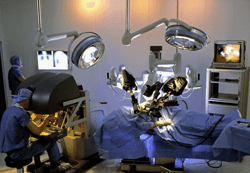
A sharing room is included in the package. A private or deluxe room adds to it, and across a three day stay the difference is modest.
Most patients go home on the second or third day. Should a complication arise, each additional night is billed. Roughly one patient in eleven has some complication after robotic prostate surgery, and most of these are minor.
The removed prostate is examined under a microscope. Should that report show that the cancer reached the edge of the tissue removed, or had spread further than the scans suggested, radiotherapy may be advised later. That is a separate cost and it is not always needed immediately.
Robotic Prostate Surgery Cost in India Compared with Other Countries
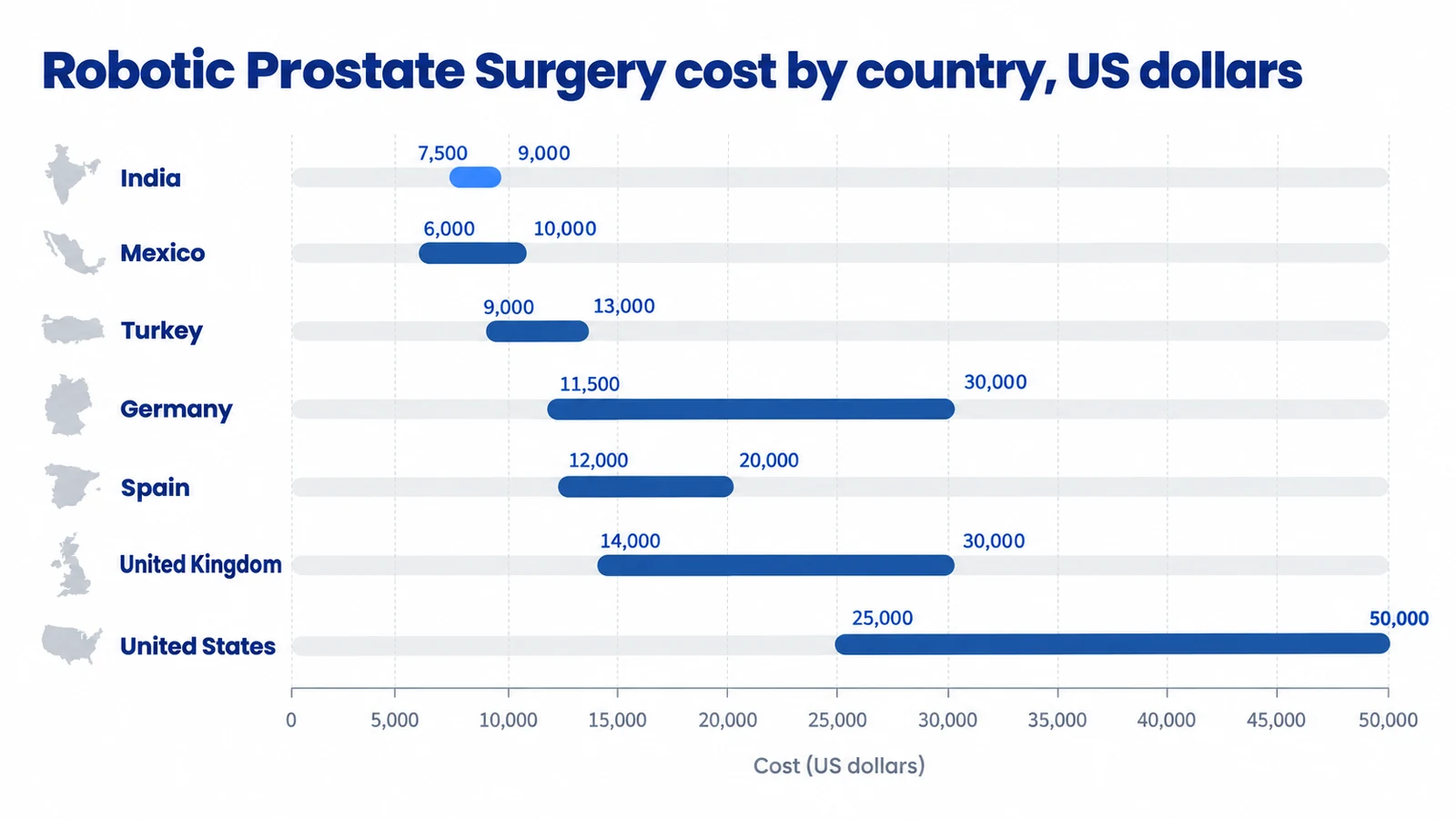
Robotic Prostate Surgery outside the United States generally costs between USD 5,000 and 15,000, against USD 25,000 to 50,000 for the same operation in an American hospital. India sits at the lower end of that range. The table below sets out what each destination costs and what your money actually buys in each one, because the two are not the same question.
| Where | Reported cost of Robotic or Radical Prostatectomy | Source of the figure |
|---|---|---|
| India, SafeMedTrip network | USD 7,500 to 9,000, negotiated per hospital | Our own package pricing |
| Mexico | USD 6,000 to 10,000 | International price comparison data, September 2026 |
| Turkey | USD 9,000 to 13,000 | International price comparison data, September 2026 |
| Germany | USD 11,500 to 30,000 | International price comparison data, September 2026 |
| Spain | USD 12,000 to 20,000 | International price comparison data, September 2026 |
| United Kingdom, private | USD 14,000 to 30,000. One of our own patients was quoted about £20,000 in a private UK hospital before he came to India | Comparison data, and a SafeMedTrip patient’s own account |
| Thailand | USD 29,300 to 32,400 | Published clinic pricing for robotic da Vinci prostatectomy, September 2026 |
| United States | USD 25,000 to 50,000 | International price comparison data, September 2026 |
Why you will also see Robotic Prostate Surgery in India quoted at USD 3,000
You will find Indian figures lower than ours quoted elsewhere, and it is useful to know what they describe. A figure of around USD 3,000 to 6,000 is what a resident of India pays, in rupees, for a prostatectomy that may be open or laparoscopic rather than robotic, and it covers the operation alone. It does not carry your pre-operative scans, your hospital stay, your accommodation, your attendant, your Medical Visa letter, your transfers or your follow up. Our range of USD 7,500 to 9,000 is a complete package for an international patient, quoted to you in writing after a doctor has read your reports, with no further billing on arrival.
Is India or Thailand cheaper for robotic prostate surgery?
Thailand is the destination most patients in South East Asia weigh against India, and for this particular operation the gap is wide. Clinic pricing for robotic da Vinci prostatectomy in Thailand sits at USD 29,300 to 32,400, which is above the lower end of the United States and about four times the Indian package. Thailand is priced competitively for many other procedures, so this surprises people. The reason is that robotic prostate surgery in India runs at high volume across a large installed base of systems, and volume is what brings a package price down.
Our patients do not travel to India for the lowest number on this table, and we would not advise anyone to choose a cancer operation that way. They travel because a hospital accredited to the same international standard, a da Vinci Robotic Surgery System of the same generation, and a surgeon who has performed this exact operation a great many times can all be had here together, at a price the rest of the table cannot match. Surgeon volume is the factor most strongly linked to your result. The next section sets out the figures.
Why the Experience of Your Surgeon Matters Most
Robotic Prostate Surgery is a highly technical procedure. It is strongly recommended that it be performed by a Urologic Surgeon trained in Oncologic surgery who has extensive laparoscopic and robotic experience. This is not a formality, and the difference it makes to your result is larger than most patients are told.
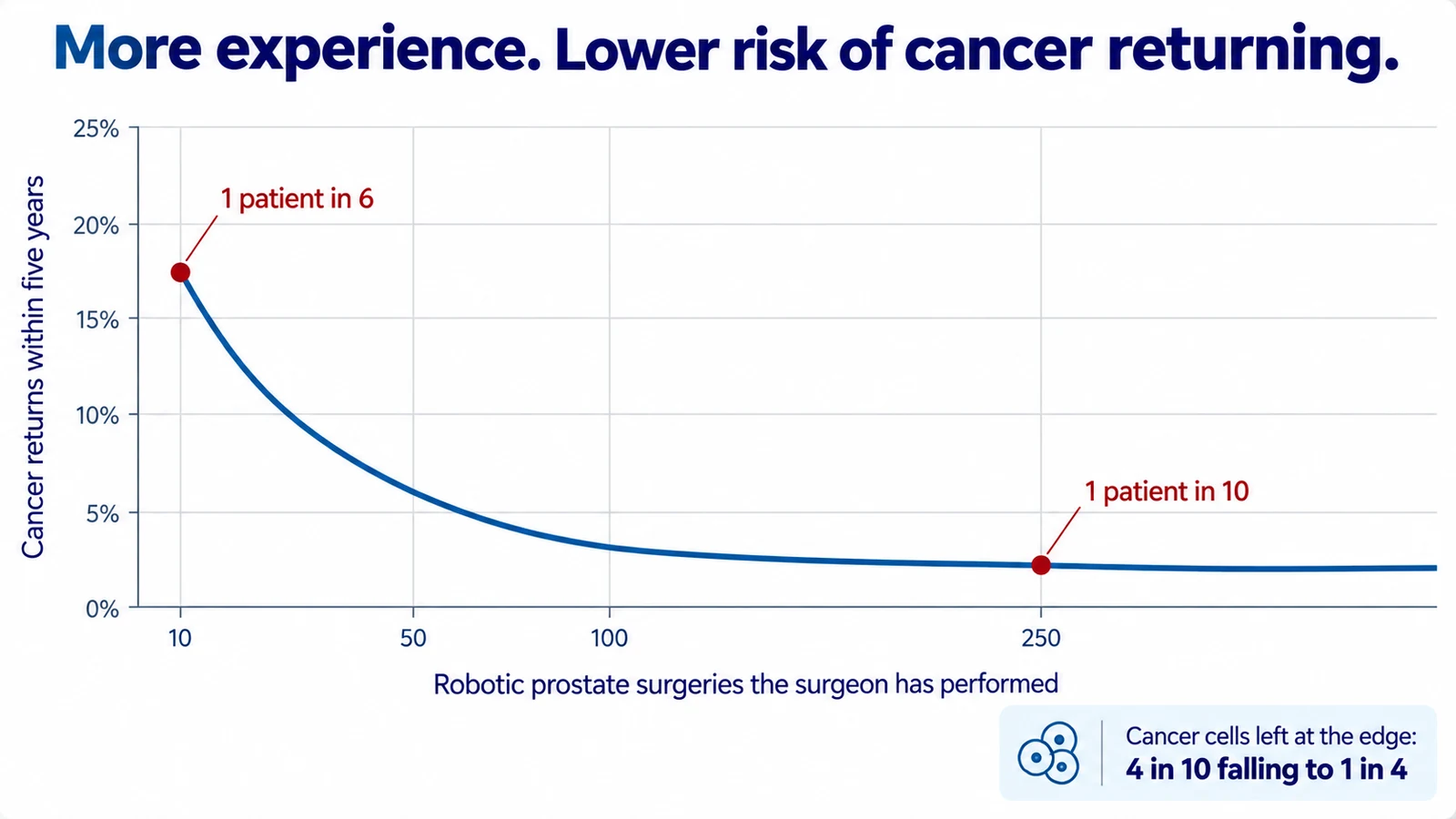
What the numbers show, across 7,765 patients treated by 72 surgeons:
- When the operation was among a surgeon’s first ten cases, about one patient in six saw the cancer return within five years.
- By the time that same surgeon had performed 250 such operations, it was about one patient in ten.
- Cancer cells left at the cut edge of the removed tissue reduced from about four cases in ten to one in four across the same range of experience.
- For cancer still confined to the prostate, freedom from recurrence approached the highest levels achievable in the hands of the most experienced surgeons.
Other work points in the same direction. A review covering more than twenty thousand patients puts the important gains a little earlier, at around one hundred operations, and found that experienced surgeons leave fewer cancer cells at the margin. A further review of 47,316 patients found that surgeons performing more than fifty of these operations a year achieved better urinary control for their patients at every point measured from six weeks to one year.
The hospital matters as well. Across 114,957 robotic prostate surgeries in the United States, hospitals performing more than 219 of these a year had markedly fewer conversions to open surgery, shorter hospital stays, fewer readmissions within a month, and fewer positive margins than hospitals performing under fifty.
The one question to ask, of any hospital anywhere. Ask how many Robotic Radical Prostatectomies the operating surgeon has personally performed. Ask it of every hospital you are considering, in your own country and abroad, and ask it of us. Ask for that one operation counted on its own, because a surgeon may have a large robotic practice across the kidney and the bladder and still have done comparatively few of these. India has more than 2,000 surgeons trained on robotic systems and over 200,000 robotic procedures already carried out, which is why a surgeon deep into this particular volume can be found here. You will be given a complete profile of the specialist before you proceed for the treatment, and you may request a teleconference with him.
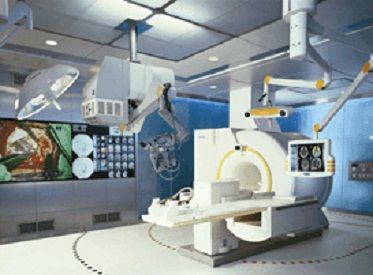
Why you should choose World Class Hospitals in India for Robotic Prostate Surgery



Country by Country Guidance: Medical Visa, Non-Stop Flights, Who Pays, and Getting Your Records Out
Wherever you are travelling from, the practical steps are the same. You send us your medical reports, we get you an Expert Medical Opinion and a Treatment Cost Estimate within 48 Hours, we arrange the registered hospital invitation letter your Medical Visa application needs, and we receive you at the airport when you land. Most of our patients come with one attendant, and accommodation for that attendant is included in your package.
Most nationalities, including the United States, the United Kingdom, Canada, the Gulf states, Malaysia, Indonesia, the Philippines, Thailand, Vietnam, Tanzania and Zimbabwe, apply for India’s e-Medical Visa online. The fee is set by nationality on the official schedule dated 15 April 2026: 80 for Canada, Australia, the Gulf states, Tanzania and Zimbabwe, 100 for the United States, 129 for the United Kingdom, and nothing at all for Bangladesh, with a bank charge of 3 percent added at payment. Two attendant visas are granted against one patient visa. Apply at least four days before you fly and no more than 120 days ahead. A small number of nationalities, Nigeria among them, must apply in person at an Indian mission, where the fee is USD 585. Your visa follows your passport and not your country of residence, which matters if you live in the Gulf on another country’s passport.
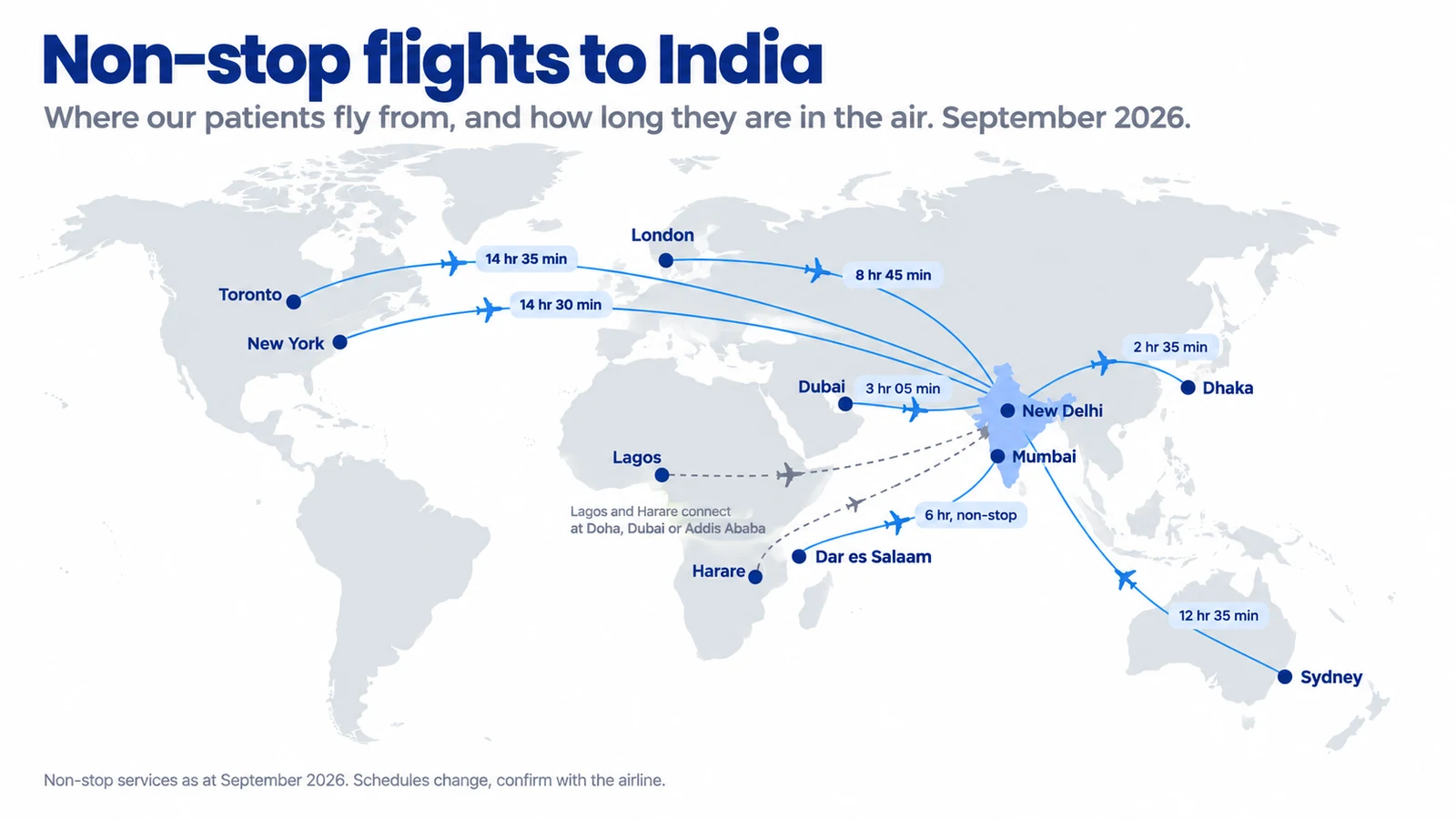
The table below sets out the non-stop services to India from the cities our patients fly from, with carriers and flying times as at September 2026. Airline schedules on the long haul routes have changed repeatedly this year, so confirm on the carrier site before you buy.
| You fly from | Non-stop to | Carriers flying non-stop | Flying time |
|---|---|---|---|
| New York (JFK and Newark) | Delhi, Mumbai | Air India, United, American | 14 hr 30 min to 16 hr |
| Toronto | Delhi, Mumbai | Air Canada, Air India | 14 hr 35 min to 16 hr 15 min |
| Vancouver | Delhi | Air India | about 16 hr 30 min |
| London Heathrow | Delhi, Mumbai, Bengaluru, Hyderabad, Chennai | British Airways, Air India, Virgin Atlantic, IndiGo | 8 hr 45 min to 10 hr 55 min |
| Dubai | Nine Indian cities, Delhi and Mumbai among them | Emirates, Air India, IndiGo, flydubai, SpiceJet | 3 hr 05 min to 4 hr 15 min |
| Doha | Delhi | Qatar Airways, Air India, IndiGo | about 3 hr 55 min |
| Dhaka | Delhi, Chennai, Kolkata, Hyderabad, Mumbai | Biman, IndiGo, Air India, US-Bangla | 2 hr 35 min to 2 hr 45 min |
| Sydney | Delhi | Air India | about 12 hr 35 min |
| Melbourne | Delhi | Air India, Qantas | about 12 hr 15 min |
| Dar es Salaam | Mumbai | Air Tanzania, IndiGo | about 6 hr |
| Lagos | No non-stop. Connect at Doha, Cairo or Addis Ababa | Qatar Airways, EgyptAir, Ethiopian Airlines | 12 hr 50 min to 14 hr 45 min in the air |
| Harare | No non-stop. Connect at Addis Ababa, Dubai or Doha | Ethiopian Airlines, Emirates, Qatar Airways | 13 hr 50 min to 16 hr 40 min |
We receive you at the airport whichever routing you take.
Detailed guidance for nine countries follows below, covering the Medical Visa fee and rules for your passport, the non-stop flights that exist at September 2026, whether any public or private scheme in your country will pay, and how to get your imaging and pathology released so our doctors can review it. If your country is not among the nine, kindly write to us and we will send you the same detail for your passport within 48 Hours.
Where are you travelling from? Open your country below. Each panel gives the Medical Visa fee and rules for that passport, the non-stop flights and flying times at September 2026, what your own health system or insurer will and will not pay for treatment in India, and how to get your scans and pathology released. If your country is not listed yet, tell us your nationality and we will send you the same detail within 48 Hours.
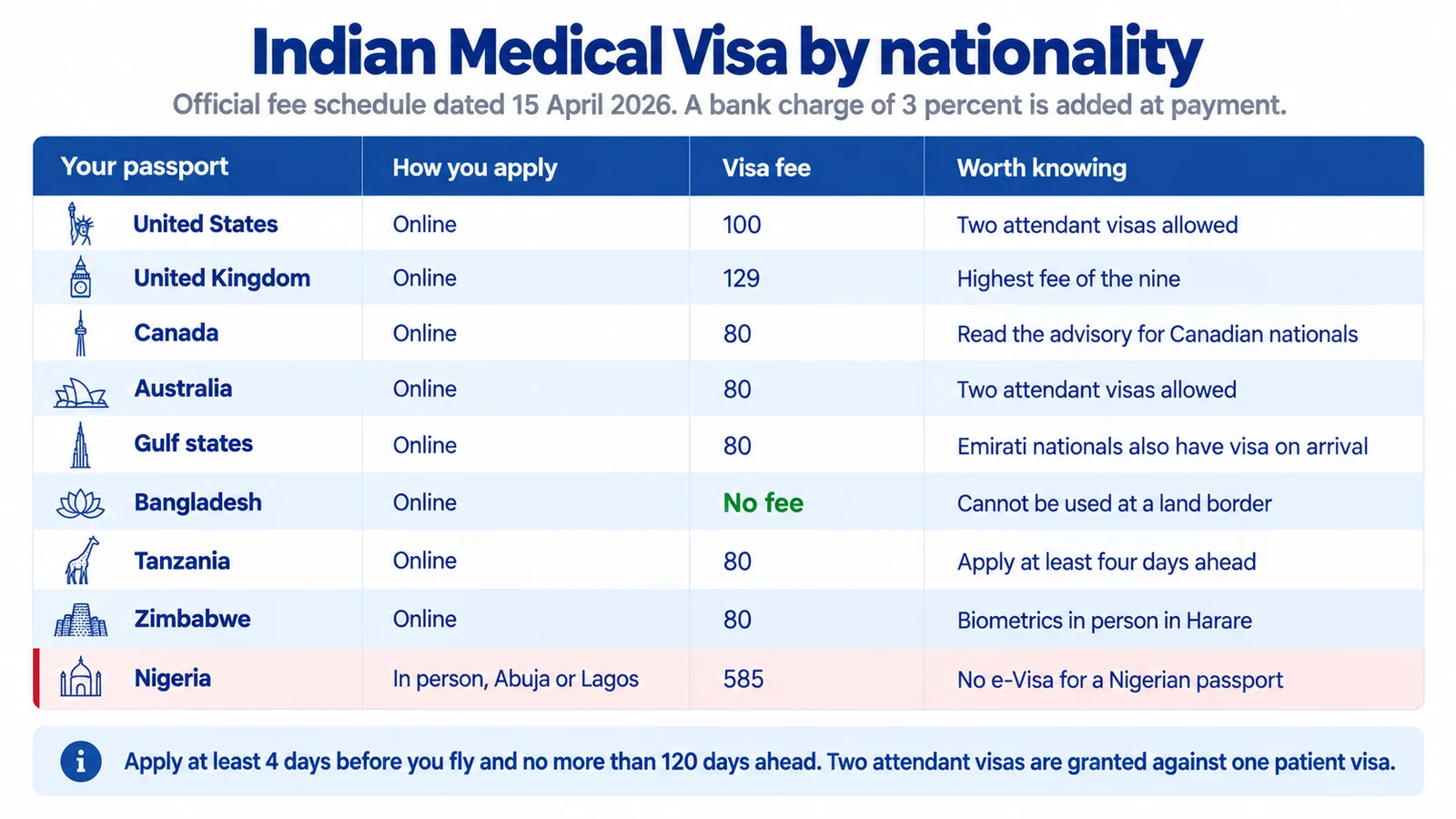
A United States passport is on India’s e-Medical Visa list, so you apply online and you do not visit a mission. The official fee schedule dated 15 April 2026 shows 100 for the e-Medical Visa and 100 for each e-Medical Attendant Visa, with a bank charge of 3 percent added at payment. The schedule prints no currency symbol against the figures, and the portal accepts payment in US dollars and Indian rupees, so budget in dollars and check the amount on the payment screen.
- Two attendant visas are granted against one patient visa, and no more
- Apply at least 4 days before you arrive, and no more than 120 days ahead
- Your passport needs six months of validity and two blank pages
- You must upload the hospital letter giving your admission date, which we obtain for you
- An e-Visa is not valid at a land border. You must arrive by air or by cruise ship at a designated port
Plan your trip to 60 days of validity, not 365. Two different validity periods appear for this visa, 365 days from arrival with multiple entries, and 60 days from first arrival. Check the validity stamped in your passport when you land.
If any parent or grandparent of yours was born in Pakistan or was permanently resident there, you cannot use the e-Visa even on a United States passport. You must apply for a regular visa at an Indian mission instead. Kindly tell us early if this applies to you, because your timeline changes.
At September 2026 the non-stop services from the United States run from New York. Newark to Delhi is flown by Air India and United, New York JFK to Delhi by Air India and American, and Air India flies Newark and JFK to Mumbai. Flying time is about 14 and a half to 16 hours. Chicago and Washington Dulles have no non-stop to India at present, and the San Francisco service is routed through Kolkata. Schedules on these routes have changed repeatedly, so confirm on the airline site before you book.
In most situations Medicare does not pay for health care you receive outside the United States. The three exceptions are all emergencies, such as an emergency inside the United States where a foreign hospital is nearer than an American one. None of them covers travelling abroad for planned surgery. Medigap pays a share of certain emergency care abroad within the first 60 days of a trip, against a lifetime cap, and that is emergency care only. A Medicare Advantage plan may add something, so ask your plan in writing. Treat this as self pay.
Your right of access under HIPAA covers this. The provider must act within 30 days and may take one extension of no more than 30 more days. You may ask for the electronic form and format you want, which is how you get your MRI and PET CT as DICOM files on a disc or a drive rather than as printed pictures. The provider may charge for labour, media and postage, and may not charge you for searching or retrieving. Ask for DICOM by name, and send it to us with your PSA history and your biopsy report.
A British passport is on India’s e-Medical Visa list. The official fee schedule dated 15 April 2026 shows 129 for the e-Medical Visa and 129 for each e-Medical Attendant Visa, with 3 percent bank charge added. A British passport carries the highest e-Medical Visa fee of any nationality we assist, so kindly build it into your budget before you reach the payment screen.
- Two attendant visas against one patient visa
- Apply at least 4 days ahead, and up to 120 days ahead
- Six months of passport validity and two blank pages
- The hospital admission letter is a required upload, and we obtain it for you
- No land border entry on an e-Visa
Plan to 60 days of validity, not 365. Two different validity periods appear for this visa, 365 days from arrival with multiple entries, and 60 days from first arrival. Check your stamp on arrival.
This catches a great many British families. If either of your parents or any of your grandparents was born in Pakistan or was permanently resident there, you are not eligible for the e-Visa on a British passport and must apply for a regular visa at an Indian mission. Tell us at the outset so we can build the extra time into your dates.
London Heathrow has non-stop services to five Indian cities. British Airways publishes about 8 hours 45 minutes to Delhi, around 9 hours to Mumbai, about 9 hours 50 minutes to Bengaluru and to Hyderabad, and 10 hours 55 minutes to Chennai. Delhi, Mumbai and Bengaluru are also served non-stop by Air India, Virgin Atlantic and IndiGo. London Gatwick has no non-stop to Delhi or Mumbai, only Air India to Ahmedabad and Amritsar.
The NHS S2 route funds planned treatment in a European Economic Area country or Switzerland. Neither the S2 route nor the EU directive route applies to treatment outside Europe. For treatment in a non European country you should speak to your integrated care board. No NHS scheme funds an elective prostatectomy in India. If your integrated care board tells you otherwise, get it in writing before you commit to dates.
Make a subject access request to whichever organisation holds your records, which is the trust or the practice rather than the NHS as a whole. The response is due within one calendar month from the day the request is received, extending to a maximum of three months where the request is complex. Ask specifically for your prostate MRI and any PET CT on disc, and for the biopsy report with the Gleason score or ISUP grade group. Send all of it to us together.
A Canadian passport is on India’s e-Medical Visa list. The official fee schedule dated 15 April 2026 shows 80 for the e-Medical Visa and 80 for each e-Medical Attendant Visa, plus the 3 percent bank charge. That is the lowest fee of the three North Atlantic countries. The Government of India portal also carries a tab headed Advisory for Canadian Nationals alongside its general instructions, and you should open and read it before you apply, because it sits outside the general rules.
- Two attendant visas against one patient visa
- Apply at least 4 days ahead, and up to 120 days ahead
- Six months of passport validity and two blank pages
- Hospital admission letter required, which we obtain for you
- No land border entry on an e-Visa
Plan to 60 days of validity, not 365. Two different validity periods appear for this visa, 365 days from arrival and 60 days from first arrival. Check your stamp when you land.
The Pakistani ancestry rule applies to Canadian passport holders in the same way. A parent or grandparent born in Pakistan or permanently resident there removes e-Visa eligibility and sends the application to an Indian mission.
Toronto has non-stop service to Delhi with Air Canada and Air India, around 16 departures a week, with a block time of about 14 hours 35 minutes to 16 hours 15 minutes. Air India flies Toronto to Mumbai three times a week at about 15 hours 10 minutes, and Vancouver to Delhi daily at about 16 hours 30 minutes. Air Canada has withdrawn from Toronto to Mumbai and Vancouver to Delhi, so a fare quoted on those pairs is usually a connecting itinerary rather than a non-stop.
Ontario requires written approval before you receive out of country services, and the application is made by your Ontario physician, not by you. Travel without that approval and you are responsible for all costs. Approval requires either that the service is not performed in Ontario by an identical or equal procedure, or that delay would cause death or medically significant irreversible tissue damage. Robotic Prostate Surgery is performed in Ontario, and a waiting list is not irreversible tissue damage, so an elective case rarely meets either condition. Travel, accommodation and meals are excluded in any event. Every province runs its own scheme, so if you are outside Ontario check your own.
Under Ontario health privacy law the custodian must respond within 30 days, with an extension of up to 30 more days where the request cannot reasonably be met in time. A fee may be charged, and you must be given an estimate first. Ask for imaging on disc and for the pathology report, and send them to us with your PSA history.
The United Arab Emirates, Bahrain, Kuwait, Oman and Qatar all appear on India’s e-Medical Visa eligibility list, and the fee for each is 80 for the patient and 80 for each of two attendants, plus the 3 percent bank charge. Emirati nationals also have a visa on arrival facility.
Saudi nationals should read this paragraph before booking a flight. Saudi Arabia does not appear anywhere on the eligibility list published on the e-Visa portal, yet the official fee table carries Saudi Arabia at entry 139 with an e-Medical Visa fee of 80, and the Embassy of India in Riyadh has extended the e-Visa facility to Saudi nationals since 17 June 2019. Saudi nationals are very likely eligible, but two Government of India sources do not agree, so kindly confirm your own case before you buy tickets. We will confirm it with the mission for you if you ask.
Your visa follows your passport and not your residence. That is the single most common mistake made by expatriate patients in the Gulf. An Indian, Pakistani, Filipino, Egyptian or British passport held by a Dubai or Doha resident is assessed on the passport, and a Pakistani passport, or Pakistani parentage or grandparentage, removes e-Visa eligibility altogether.
You are closer to our hospitals than most Indian patients are. Emirates alone operates 167 flights a week from Dubai to nine Indian cities, being Ahmedabad, Bengaluru, Chennai, Delhi, Hyderabad, Kochi, Kolkata, Mumbai and Thiruvananthapuram. Dubai to Delhi is flown non-stop by five carriers with around twelve departures a day at 3 hours 5 minutes to 4 hours 15 minutes. Dubai to Mumbai is flown non-stop by five carriers around eleven times a day at about 3 hours 15 minutes. Doha to Delhi is flown non-stop by three carriers, nineteen times a week, at about 3 hours 55 minutes. A three hour flight home is easier to manage after surgery than a twelve hour one.
Dubai’s mandatory Essential Benefits Plan covers non emergency care in Dubai and the Northern Emirates only, and does not reach outside the country. Higher tier private cover can reach India. Daman’s Premier schedule shows worldwide area of cover, limits cover outside the UAE to 180 days per treatment, requires pre-authorisation for treatment outside the UAE, and warns that where pre-notification is not obtained on a non emergency case the claim may be reduced to 80 percent of the actual costs. The Gulf government treatment abroad schemes all require that the treatment is unavailable at home, and an elective prostatectomy in India does not meet that requirement. Ask your insurer in writing, before you fly, and send us the reply.
Arabic support at the hospital is a service to be arranged and not a default, and we will have an interpreter named for your consent, your pathology result and your discharge instructions if you want one.
An Australian passport is on India’s e-Medical Visa list. The fee is 80 for the patient and 80 for each of two attendants, plus the 3 percent bank charge. Apply at least 4 days before arrival and up to 120 days ahead, with six months of passport validity, two blank pages and the hospital admission letter we obtain for you. Two different validity periods appear for this visa, 365 days and 60 days, so plan to 60 days. The Pakistani ancestry rule applies to Australian passport holders as it does to every other nationality.
Air India flies Delhi to Sydney non-stop, daily, at about 12 hours 35 minutes, and is the only carrier doing so. Delhi to Melbourne is flown by Air India and Qantas about four times a week at around 12 hours 15 minutes, and Qantas describes its Melbourne service as seasonal from 26 October 2026 to 27 March 2027. Qantas has suspended Sydney to Bengaluru from 8 August to 24 October 2026. If your hospital is in Mumbai, Chennai or Bengaluru you will connect through Delhi or through a Gulf hub.
Australian patients are caught by this more often than by anything else. Cover-More, the largest Australian travel insurer, excludes claims arising from travel booked or undertaken to seek or obtain medical treatment, and separately excludes claims arising from elective surgery during the journey, including any complication, even where an existing medical condition has been approved. The first of those exclusions attaches to the purpose of the trip. On that wording a post operative complication, an unrelated illness, a cancelled flight home and a medical evacuation can all fall outside cover.
What to do about it. Buy a policy that is underwritten for medical travel rather than a standard holiday policy, or arrange complication cover through the hospital, and get the position in writing before you leave. We will put the question to the hospital in writing for you.
Medicare Australia is unlikely to cover treatment obtained overseas, Australia holds reciprocal health agreements with only eleven countries and India is not among them, and private health cover for overseas treatment remains limited. The Australian patient is self funding. The case for India is the price and the waiting time set against the Australian private system, not reimbursement. Plan for your follow up care in Australia before you travel, because continuity of care is the part that is most often left to chance.
Bangladesh appears on India’s e-Medical Visa eligibility list, and the official fee table shows the e-Medical Visa and the e-Medical Attendant Visa for Bangladeshi nationals at 00. There is no fee. The 3 percent bank charge is a percentage of the fee, so you pay nothing there either. Two attendants are permitted, you apply at least 4 days before arrival and up to 120 days ahead, and you upload the hospital admission letter, which we obtain for you.
A great deal of Bangladeshi travel to India goes overland through Benapole and Petrapole and the other integrated check posts. An e-Medical Visa does not work there. You may only enter through the designated airports and seaports. A patient who takes the free e-Medical Visa and then drives to the border will be turned back. If you need to cross by land you need the paper Medical Visa from the visa application centre instead. You may leave India from any immigration check post either way.
One more thing that catches Bangladeshi travellers. The allowance for bringing Indian currency notes into India by air does not extend to Bangladeshi citizens, so do not plan on carrying rupee notes in.
Dhaka to Delhi is flown non-stop by Air India, Biman and IndiGo, about fourteen times a week, at around 2 hours 35 minutes. Dhaka to Chennai is flown non-stop by Biman, IndiGo and US-Bangla, about seven times a week, at around 2 hours 45 minutes. Kolkata, Hyderabad and Mumbai are also served non-stop. There is no non-stop between Dhaka and Bengaluru.
Bangladesh Bank permits an authorised dealer to release up to USD 15,000 for travel abroad on health grounds, against recommendations from medical specialists and a cost estimate from the foreign institution, on the prescribed form in duplicate. The ceiling was raised from USD 10,000 in 2025. Above USD 15,000 the bank must obtain central bank approval on your behalf. A treatment package of USD 7,500 to 9,000 sits comfortably inside the quota, which is why the written estimate matters. Ask us for the hospital estimate first, then take it to your bank.
Nigeria is not on India’s e-Visa list. There is no e-Visa facility for Nigerian nationals. Every application is submitted in person at the High Commission in Abuja or the Consulate General in Lagos, with physical copies of your documents. Should any agent advise you to apply for an Indian e-Medical Visa online, that advice is incorrect for a Nigerian passport and following it will cost you weeks.
- Online registration first on the Indian visa portal, then submission in person in Abuja or Lagos
- Invitation letter from the Indian hospital, registered with the FRRO and carrying a file reference number, which we will arrange for you
- A current referral letter or medical report from a Government Hospital in Nigeria
- Your medical history, and for a follow up case the last discharge report
- A signed sponsorship letter, with the sponsor’s passport copy and National ID
- The sponsor’s bank statements for the last three months
- Proof of your relationship with the attendant travelling with you
- Passport valid for at least six months
The fee at the Abuja mission is USD 585 with a USD 3 welfare charge, paid in naira at the bank counter on the mission premises. Where your case is urgent, the mission accepts walk in medical applications between 09:00 and 11:00 on working days without a prior appointment.
There is no direct flight from Lagos to Delhi. The practical routings are through Doha with Qatar Airways at about 12 hours 50 minutes of flying, through Cairo with EgyptAir at about 13 hours 50 minutes, or through Addis Ababa with Ethiopian Airlines at about 14 hours 45 minutes. We will receive you at the airport on arrival.
This is where Nigerian patients lose the most time, so kindly plan it early. Naira debit cards carry monthly and quarterly international spending limits that fall well below a surgical package, and several fintech cards cannot be used internationally at all. The route that works is a domiciliary account and a telegraphic transfer to the hospital, arranged once your written estimate is in hand. Please confirm your own bank’s current limit before you book anything, as these limits change. You will directly pay the hospital after you arrive in India.
Many Tanzanian patients assume that coming to India means a full day of travel with a connection in the Gulf. It does not. Air Tanzania operates a daily non stop service from Dar es Salaam to Mumbai with a flying time of about six hours, and IndiGo also serves this route. Several of our network hospitals are in Mumbai itself, and Delhi is a further two hour domestic flight. A single six hour flight home is easier to manage after surgery than a Gulf connection with a wait in between.
Tanzania is on India’s e-Visa list, so you may apply for an e-Medical Visa without attending the High Commission. Please apply at least four days before you travel. The fee is USD 80 for you and USD 80 for each attendant, with a 3 percent bank charge. Two Medical Attendant Visas are granted against one Medical Visa, so two family members may accompany you.
One point to note. India’s own e-Visa page carries two different validity periods, one year with multiple entries, and 60 days from first arrival. Kindly plan around 60 days and ask us to confirm the current position for your dates before you book your tickets. The regular Medical Visa from the High Commission in Dar es Salaam runs up to six months or the duration of your treatment, whichever is less, allows up to two escorts, and requires FRRO registration within 14 days of your arrival.
A 2024 survey of all five Tanzanian tertiary hospitals treating Prostate Cancer, being Ocean Road Cancer Institute, Muhimbili National Hospital, Mbeya Zonal Referral, KCMC Moshi and Bugando Medical Centre, reported the following:
- Robotic surgery was not available at any of the five hospitals
- Radiotherapy was available at only two of the five
- Transrectal ultrasound was available at only one
- No hospital offered MRI guided biopsy
- Biopsy results could take up to six weeks to come back
- Staffing at most sites was below 40 percent of the established requirement
The same survey looked at 1,503 Prostate Cancer patients seen across those hospitals during 2022. Their average age was 72 years, more than four in five had already reached an advanced stage by the time they were seen, and two in three had a high grade cancer on biopsy.
Why this matters to you. Those figures describe men who were diagnosed late. If your cancer has been found early, while it is still inside the prostate, you are in the group that surgery helps the most, and this is exactly the situation in which the surgeon’s experience decides the outcome.
International cancer agency figures for 2024 record 3,635 new Prostate Cancer cases and 2,298 deaths in Zimbabwe in a single year. Prostate Cancer accounts for more than a third of all cancers diagnosed in Zimbabwean men, making it the most common by a wide margin, and the second most common cancer in the country across both sexes.
Prostate Cancer care in Zimbabwe is concentrated at two public tertiary centres, Parirenyatwa in Harare and Mpilo Central in Bulawayo, and consists of radiotherapy and open surgery. Government has committed around USD 30 million to cancer equipment at these two hospitals, with a higher energy radiotherapy machine at Mpilo due to complete installation during 2026. There is no robotic surgical system anywhere in Zimbabwe.
There is no direct flight from Harare to Delhi. The quickest routing is through Addis Ababa with Ethiopian Airlines at around 13 hours 50 minutes, followed by Emirates through Dubai at about 16 hours 25 minutes and Qatar Airways through Doha at about 16 hours 40 minutes.
This is the most useful thing a Zimbabwean patient can know before starting. The medical visa checklist in Harare requires a patient on medical aid to supply a letter from the Medical Aid Society confirming admissibility, a guarantee for the expenses, and proof of the funds being transferred to India. The visa process is built around societies that do fund treatment in India. Please speak to your society before assuming that you must meet this cost yourself.
- Zimbabwe is on the e-Medical Visa list, so you may apply online. Should you use the regular Medical Visa instead, it is online registration, a printed and signed form, then biometric enrolment in person in Harare. Diplomatic passport holders, children under 12 and applicants over 70 are exempt from biometrics
- Passport valid at least six months with three blank pages
- Return air tickets
- A letter from your local hospital or doctor with your complete local treatment records
- A letter from the Indian hospital naming both you and your attendant and stating the estimated cost of treatment, which the hospital must also email directly to the mission. We will arrange this letter for you
- A certified bank statement, and a sponsor affidavit where a third party is funding you
- Proof of your relationship with your attendant
The fee under the Zimbabwe schedule is USD 80 for a single or multiple entry visa of up to six months. Payment is straightforward from Zimbabwe, as the United States dollar remains legal tender there for settlement until the end of 2030.
Your Treatment Journey in India, Day by Day
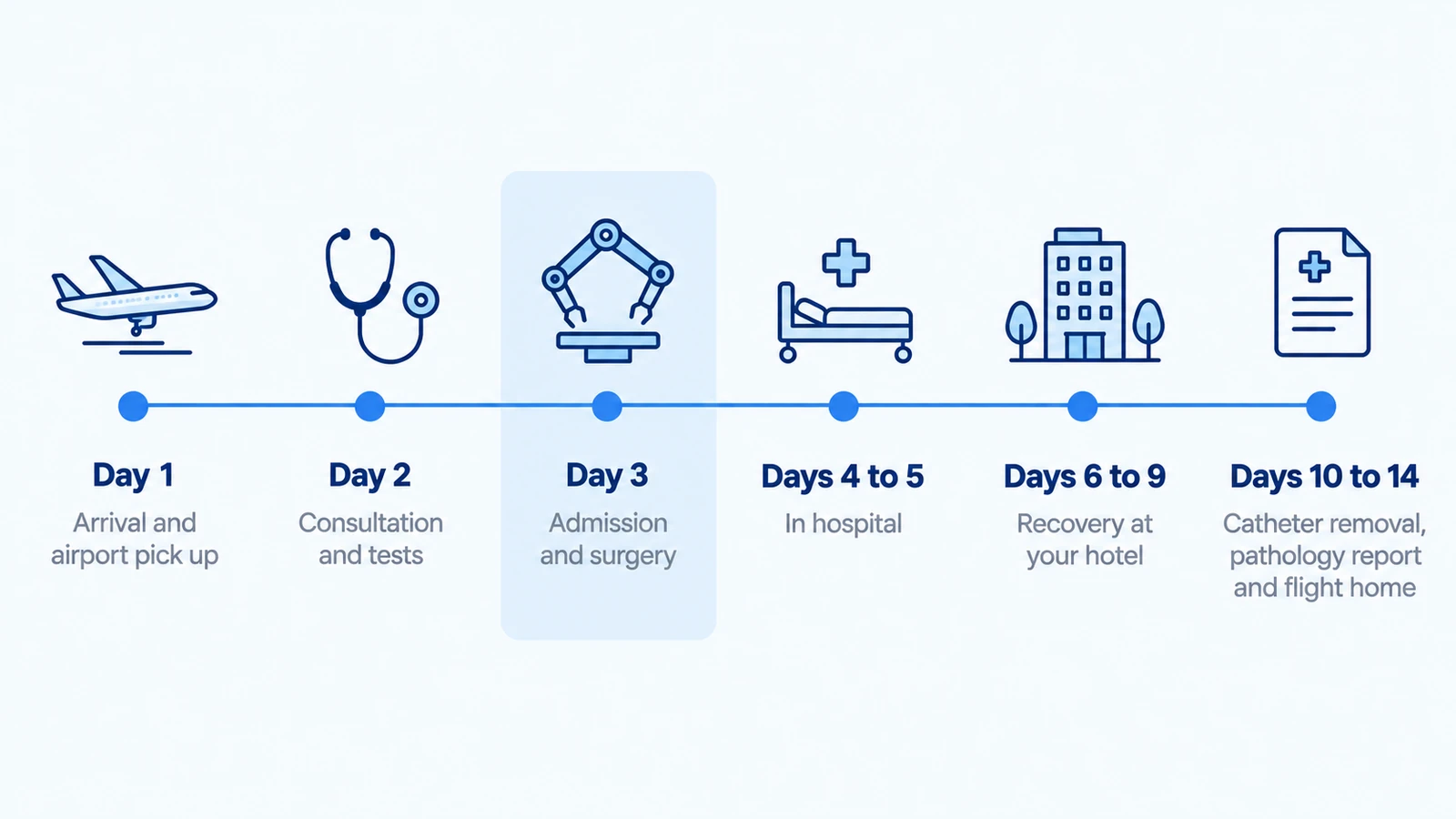
This is what happens on each day of a typical fourteen day stay. Individual cases vary, and your surgeon’s plan takes precedence over anything written here.
You send us your PSA history, your biopsy report with the Gleason or ISUP grade, and any MRI, CT or bone scan. Our doctors review them. You receive a written plan and a costed package, and the hospital issues the invitation letter your visa application needs. Nothing is paid in advance.
You are received at the airport and taken to your accommodation. Should you land in the morning, hospital registration can often be completed the same day.
You meet the operating surgeon face to face. Blood work, cardiac clearance, anaesthetic assessment, and any imaging the surgeon wishes to repeat. Your plan is confirmed at this point, based on what is actually in front of the doctor.
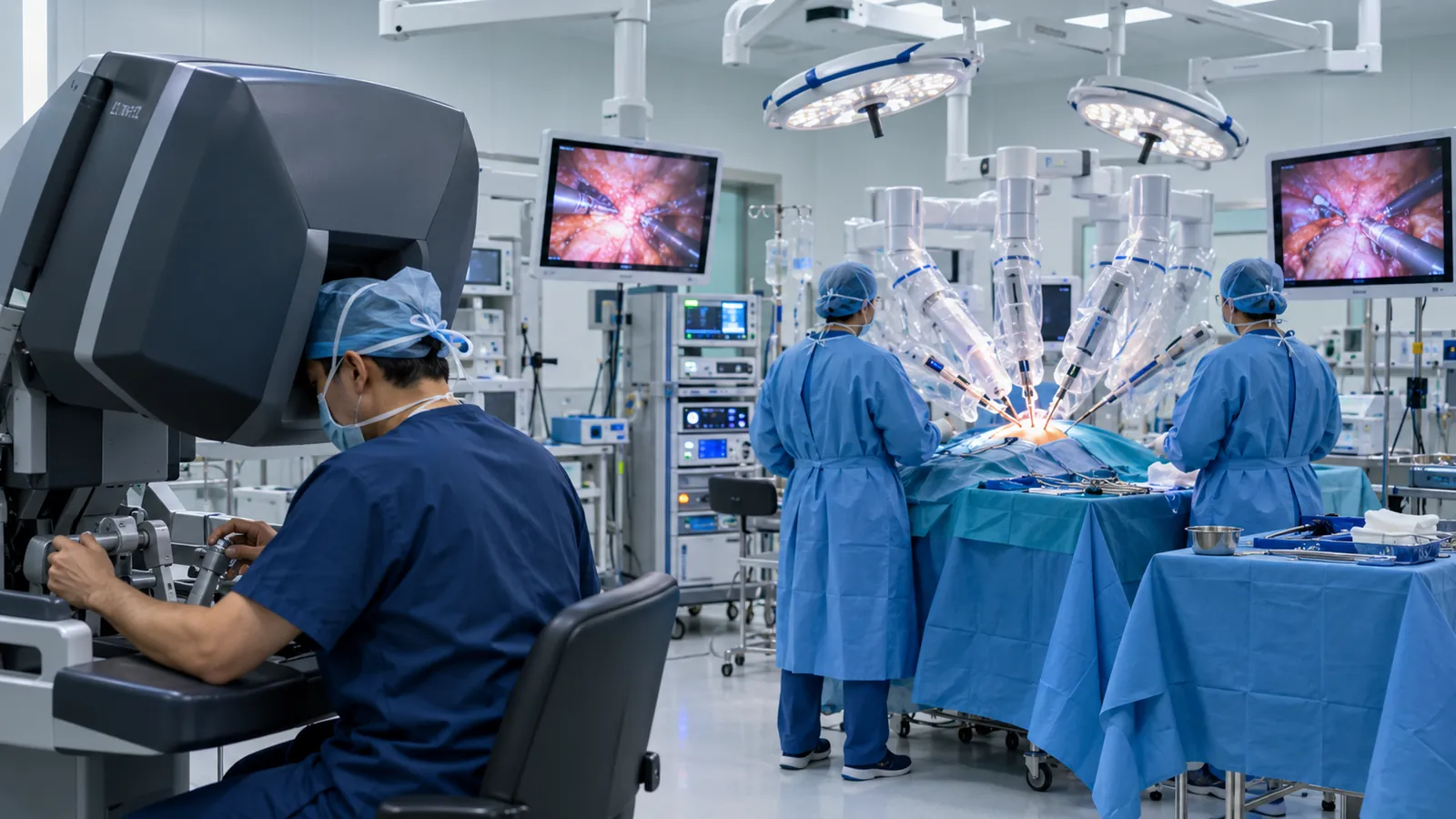
You are admitted and the procedure is performed. Robotic Prostate Surgery takes around two and a half hours of theatre time. Blood loss is minimal, averaging under 200 millilitres, and roughly one patient in fifty requires a transfusion.
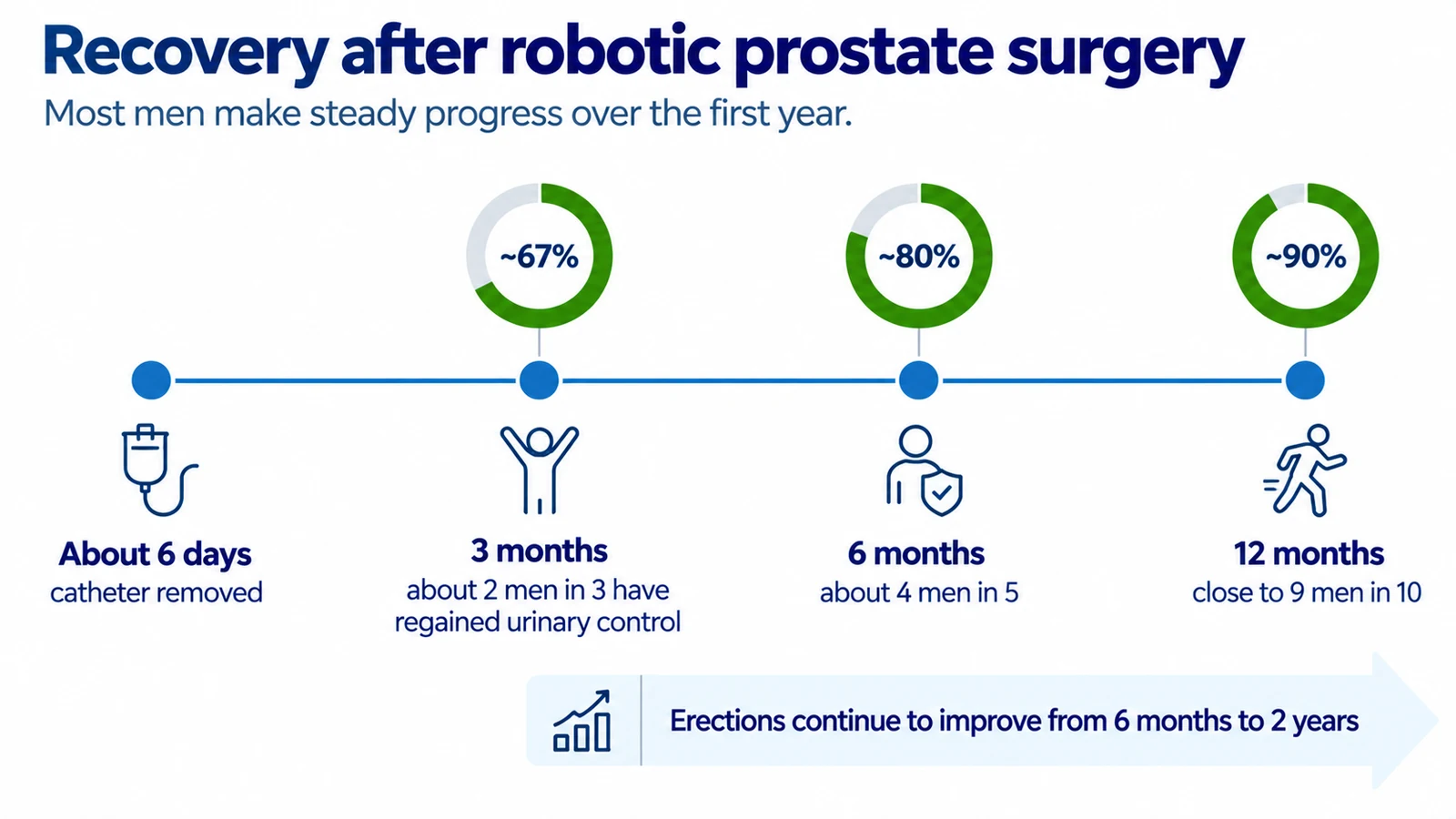
You are generally walking the day after surgery. Most patients are discharged on the second or third day, with the catheter still in place.
You stay locally with your attendant, in a hotel or guest house that we will help you select to fit your budget. This is why your total stay is longer than your hospital stay.
Your catheter is removed at a short clinic visit. The day is decided by your surgeon and it is not the same for every patient, so it may come out earlier than you expect or a little later. Your pathology report on the removed prostate is normally ready before you fly home. This report is the single most important document of your whole trip, as it tells you the true stage and grade, whether the margins were clear, and whether anything further is advised.
A final review with your surgeon, a written discharge summary, your pathology report, and a follow up schedule that your own urologist can act upon. Your first PSA test is due about two months after surgery and you have it done in your own country.
Centers of Excellence for Robotic Prostate Surgery in India.
Your Robotic Prostate Surgery is carried out at World Class Hospitals in India that hold the same international accreditations as the leading hospitals of the United States and Europe. India today has more than 275 da Vinci Robotic Surgery Systems installed, over 2,000 surgeons trained to operate them, and more than 200,000 robotic procedures already carried out. In September 2026 the newest generation system, da Vinci 5, was introduced in India as well. This is why your treatment can be arranged here with a zero waiting period and without any compromise in standard.
The hospitals we place our patients with hold accreditation from Joint Commission International of the United States, and are NABH accredited in India. Both of these are listed in public registers that you are free to check yourself before you travel. NABH standards are themselves accredited by ISQua, and the laboratories that will process your biopsy and your PSA tests are separately NABL accredited.
- Surgical safety and infection prevention inside the operating theatre
- Medication safety, with adverse reactions tracked and reported
- Your treatment delivered only by credentialed specialists
- Informed consent explained to you in a language you understand
- Re-inspection on a fixed cycle, so the standard has to be held rather than awarded once
What does NABH accreditation actually involve?
NABH is a board of the Quality Council of India, set up in 2006, and 1,299 hospitals in India now hold its accreditation. Its own standards are accredited by ISQua, the international body that accredits the accrediting bodies, so an Indian accreditation is recognised outside India. The standards run to ten chapters. They cover how you are assessed on arrival and how your care carries on from one department to the next, how your medication is managed, your rights as a patient and what you must be told, hospital infection control, patient safety and quality improvement, the responsibilities of the management, the safety of the building itself, how staff are recruited and credentialed, and how your records are kept. A hospital is inspected against all ten, and inspected again on a cycle.
What does JCI accreditation add on top of that?
Joint Commission International accredits 47 organisations in India. It is the same body that accredits hospitals in the United States, and it applies the same manual here that it applies there, so a hospital holding it has been measured against an American standard rather than a local one. You can look up any hospital in the Joint Commission International register yourself before you agree to anything.
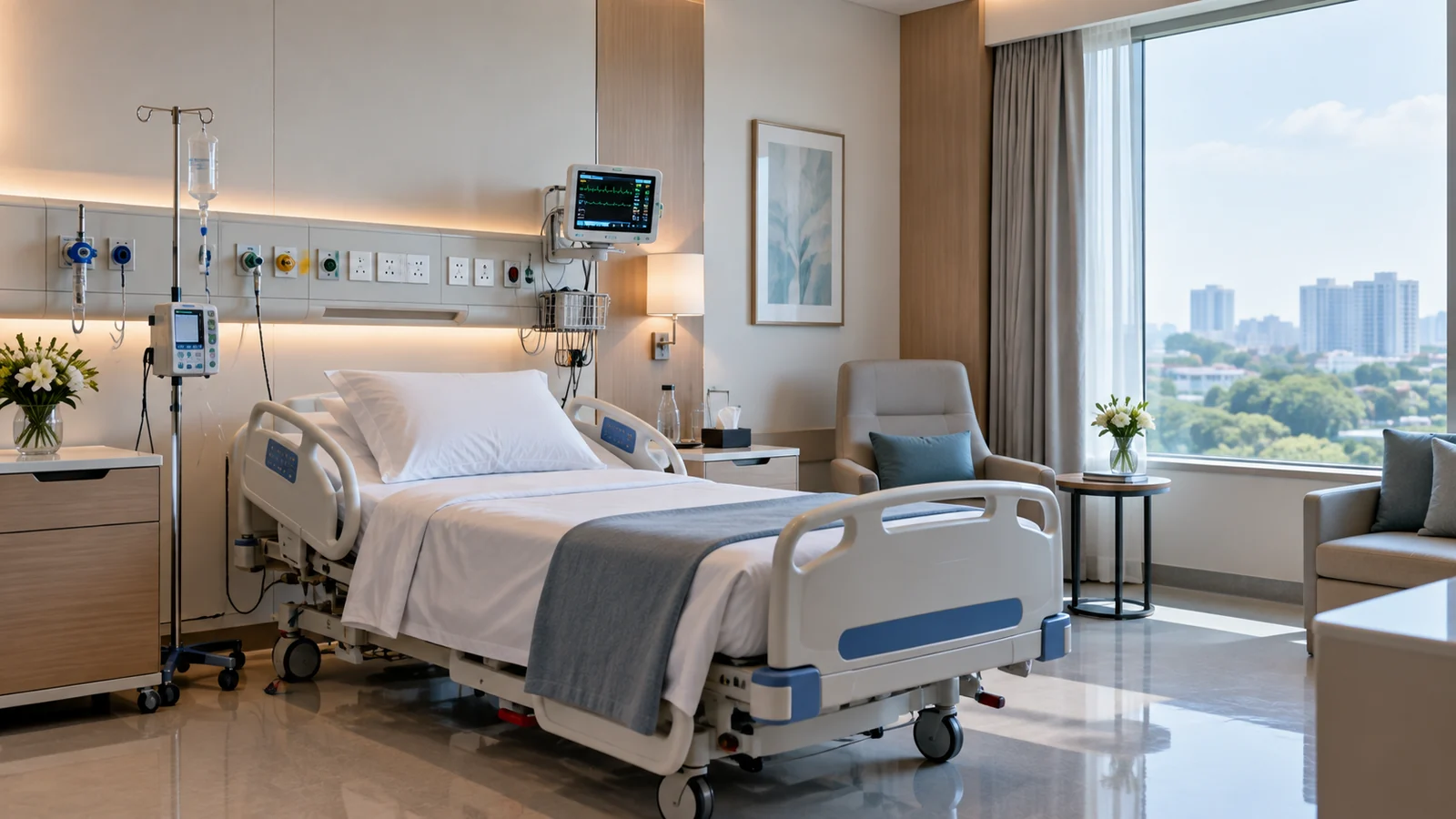
Your MRI, your PSMA PET CT scan, your biopsy, your pathology, your surgery and your recovery all take place inside the same hospital. Nothing is sent out to a third party and nothing waits for an appointment somewhere else. That matters when you have flown in for a fixed number of days.
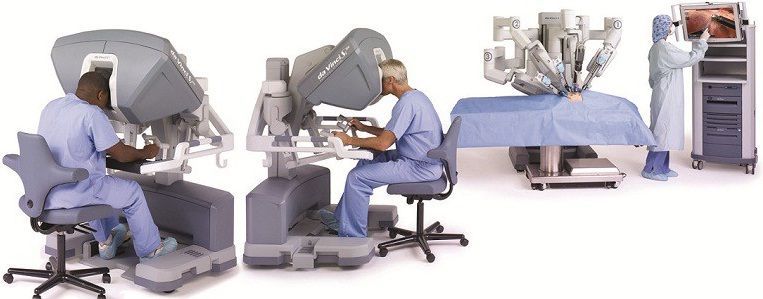
Your surgery is carried out on a da Vinci Robotic Surgery System, the same equipment used in American and European hospitals. The newest generation, da Vinci 5, carries force feedback, which allows your surgeon to feel the tension of the tissue he is working on, along with a far more detailed three dimensional view of the operating field.
How We Select the Surgeon Who Will Operate on You
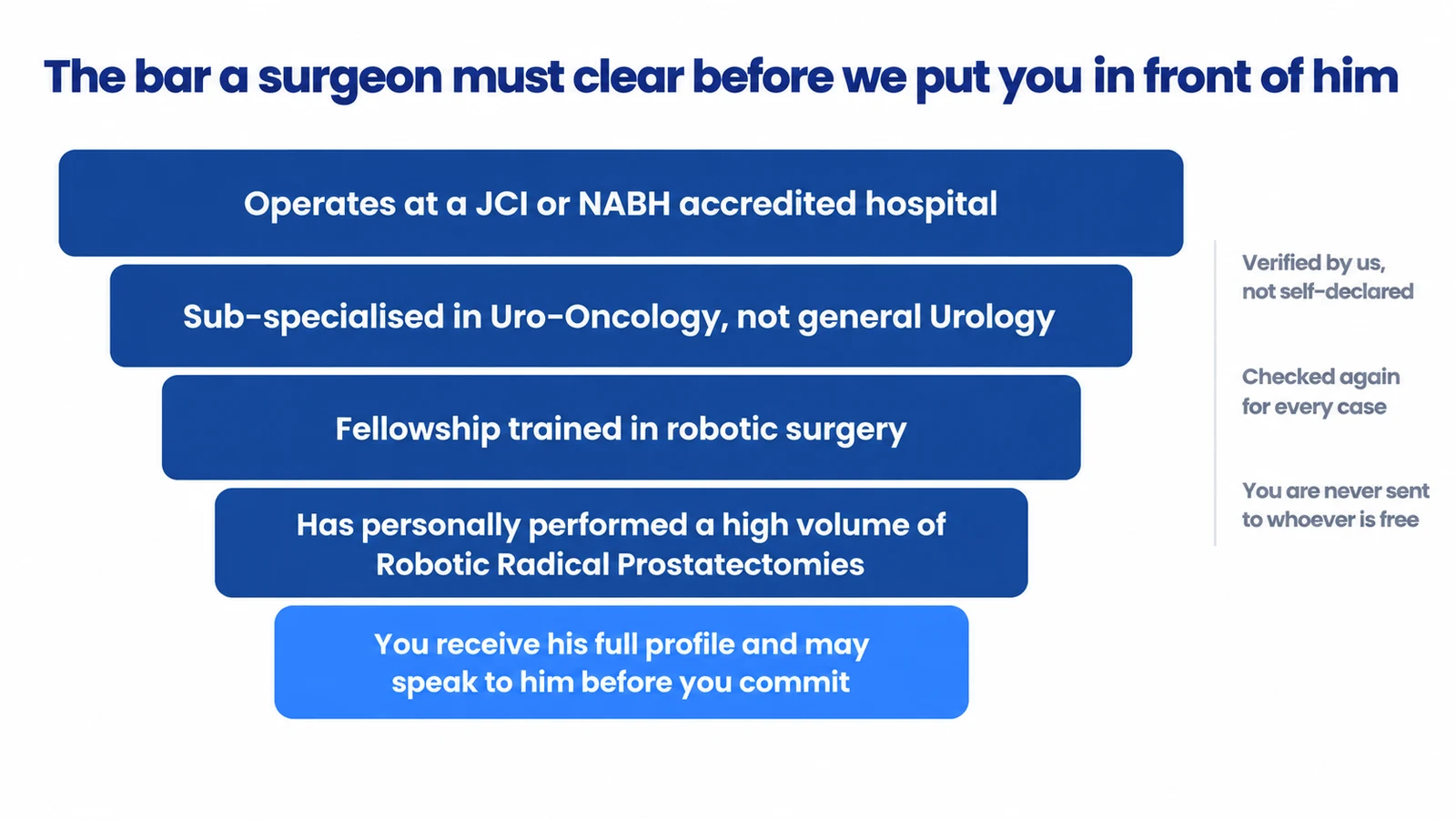
You will not be sent to whichever surgeon happens to be free that week. Before we place your case with any hospital, the surgeon who is to operate on you has to meet a standard that we set and check ourselves, and the most important item on that list is the number of these operations he has already performed.
- He operates at a JCI or NABH accredited hospital
- He is sub specialised in Uro-Oncology, not general Urology
- He is fellowship trained in robotic surgery
- He has personally performed a high volume of Robotic Radical Prostatectomies, counted as that operation alone and not as robotic surgeries of every kind added together
- His outcomes for each case we place are reviewed with us
How many robotic cases must a surgeon have done before he is allowed to operate on you?
The American Urological Association sets out what a urologist must complete before a hospital may grant him robotic operating privileges. Through the training route that is a minimum of twenty robotic cases, with console time for a key portion of at least ten of them. A urologist already in practice may instead complete a written module at eighty percent, hold open or laparoscopic privileges for the same operation, and be proctored, and the proctor himself needs fifty robotic cases in total with twenty of them similar to the one he is watching.
Those are the requirements to be allowed to operate. Results continue to improve well beyond them. Recurrence keeps falling up to two hundred and fifty of these operations, and urinary control still improving in the hands of surgeons carrying out more than fifty a year. A surgeon can meet every credentialing requirement and still be well below the volume linked to better outcomes. We therefore ask for the count, and we ask for it as this one operation rather than robotic surgeries of every kind added together.
Once we receive your medical reports, we will get you an Expert Medical Opinion and a Treatment Cost Estimate within 48 Hours, with No Obligation. You will be given the complete profile of the specialist who is to carry out your treatment, covering his qualifications, his sub speciality and the volume of these surgeries he has performed, and you may request a one to one discussion with him by video call before you decide anything.
Your SafeMedTrip Patient Case Manager stays with your case from arrival to send off, so that there is always one person you can ask.
What Your International Patient Service Covers
Open the full list of what we arrange for you, from the airport to your flight home
SafeMedTrip has been arranging treatment in India for patients from other countries since 2009, which is seventeen years. We charge you no service fee at any stage, and you pay the hospital directly after you arrive.
- A registered invitation letter from the hospital for your Medical Visa, arranged by us
- Airport reception on arrival and your transfers throughout
- Accommodation for the attendant travelling with you
- Well trained English speaking Doctors, Nurses and Support Staff, and an interpreter where you need one
- A zero waiting period, with your dates fixed before you fly
- Highly Negotiated Treatment Packages, quoted to you after more than one hospital has reviewed your reports
- Your written discharge summary, your pathology report and a follow up schedule your own doctor at home can act upon
- Your SafeMedTrip Patient Case Manager with you from arrival to send off
Results You Can Expect after Robotic Prostate Surgery
You deserve real figures rather than a promise, so that you can discuss your own case properly with the doctor. The numbers below come from very large groups of men followed up after this operation.
Urinary control returns gradually rather than at once. Across a very large body of reported cases, about two men in three had regained control by three months, four in five by six months, and close to nine in ten by one year. Where patients themselves were surveyed rather than their surgeons, about one man in five still reported some leakage at one year, so please treat the higher figures as the best case. Your age, your weight and your urinary symptoms before surgery are the strongest indicators of how you will do, and pelvic floor exercises started early are of real help.
Recovery of erections varies more than any other outcome. Reported recovery at one year runs from about half of men to nine in ten, and patient surveys sit at the lower end of that range. What predicts your own result is your age, how good your erections were before surgery, your general health, and whether nerve sparing was possible. In one large series of robotic cases, men aged 45 and under did considerably better at one year than men in their early fifties. Where nerve sparing is possible, function continues to improve over six months to two years and can be supported with medication or a rehabilitation programme.
Cancer cells are found at the cut edge of the removed tissue in roughly one case in seven overall, and about one case in eleven where the disease turns out to be confined to the prostate. This is a signal to watch your PSA closely rather than a verdict, and radiotherapy remains fully available afterwards. Close to nine in ten men are free of any rise in PSA at five years, and about three in four at ten years, with freedom from spread at ten years above nine in ten.
- Ejaculation ends permanently. The prostate and seminal vesicles produce semen and both are removed. Orgasm remains possible for most men but is dry, and natural fertility ends. Should fathering a child matter to you, kindly discuss sperm banking before the operation.
- About one man in three needs radiotherapy later. Among men who had at least one unfavourable feature on their pathology report, about a third went on to have radiotherapy within eight years.
- Giving radiotherapy to everyone immediately after surgery does not help. Watching the PSA and treating early if it rises is the accepted approach, and it spares the men who never need it.
- Some men experience leakage at orgasm. Reported rates vary widely from around one in four upward, and the studies are of low quality, so raise it with your surgeon rather than relying on any single number.
- A small loss of penile length is measurable, averaging under one centimetre when measured objectively, greatest at catheter removal and reducing over the following year.
- Inguinal hernia becomes a little more likely, affecting about one man in thirteen after robotic surgery, against about one in seven after open surgery.
Benefits of Robotic Surgery Compared with Open Surgery
Across large international series, Robotic Prostate Surgery delivers the following against the open operation:
- Substantially less blood loss, a difference of more than half a litre
- Far fewer blood transfusions
- A hospital stay shorter by about one and a half days
- Fewer complications overall
- A higher chance that nerve sparing can be achieved
- Earlier return to normal activity and to work
Where robotic and open surgery are compared for urinary control, sexual function and cancer clearance, the difference between the two methods is smaller than the difference between one surgeon and another. The number of operations your surgeon has performed therefore matters more to your result than the method does. Choose an experienced surgeon you trust, and the method will follow from his advice about your particular cancer.
Is Robotic Prostate Surgery the Right Choice for You?
Open this to see where surgery is the right choice, where monitoring is better, where radiotherapy is preferred, and what happens if the cancer has already spread
Surgery is not the right answer for every man with Prostate Cancer. Our doctors will tell you before you travel where another treatment suits your reports better, so that you take this decision with the full picture in front of you.
Men with intermediate or high risk cancer that is still localised, who are otherwise in good health and have a life expectancy beyond ten years, gain the most. Surgery also gives you a true pathological stage and node status, and it keeps radiotherapy available afterwards should you need it.
Men with low risk disease, meaning ISUP Grade Group 1 with a PSA under 10 and an early clinical stage, are usually better served by active surveillance, which means careful monitoring rather than immediate treatment. Over ten to fifteen years of surveillance, deaths from Prostate Cancer in this group remain very low. Surgery in this group can cause side effects without adding years to your life.
Among 1,643 men followed for fifteen years and allotted to surgery, radiotherapy or monitoring, deaths from Prostate Cancer were low and broadly similar in all three groups, at fewer than one man in thirty. Surgery and radiotherapy did roughly halve the rate at which the cancer spread. The reasonable conclusion is that surgery reduces spread and progression, that radiotherapy is a genuine alternative rather than a second best, and that your own stage, grade and general health should decide this, not a website.
Radiotherapy combined with hormone therapy is the equal alternative for high risk and locally advanced disease, and is generally preferred where the cancer has spread widely within the pelvis or where other illnesses make surgery risky. Hormone therapy on its own does not cure localised Prostate Cancer. Our doctors will tell you which of these applies to your own reports.
This question is settled before anything else, by a PSMA PET CT scan. Among 302 men with high risk Prostate Cancer scanned before surgery, the PSMA PET CT scan gave the correct answer about the spread of the disease for roughly nine men in ten, where the older combination of a CT scan and a bone scan was correct for roughly six or seven in ten. It left an unclear result far less often and used less than half the radiation. For about one man in four it changed the treatment that had been planned for him. Your scan is carried out at the same hospital that will treat you, and your treatment plan follows the scan rather than the other way round.
If your scan shows that the disease has spread beyond the prostate and the pelvis, a Radical Prostatectomy is not the operation for you, and our doctors will advise you of this from your reports before you travel. The treatment that applies then is targeted radioligand therapy using Lutetium-177 PSMA, which is given as an infusion and seeks out prostate cancer cells wherever they have settled in the body. It was approved in the United States in March 2022 for men who had already had hormone treatment and chemotherapy, and that approval was widened in March 2025 so that it can now be given before chemotherapy rather than only after it. This treatment is available at our hospitals in India, and we will arrange an opinion on whether it suits your reports.
Important Questions to Ask Before You Decide
Please put these to us, and put them to every other hospital you speak to, including the one in your own city.
- How many Robotic Radical Prostatectomies has the operating surgeon personally performed? Not the hospital. The surgeon.
- How many does this hospital perform in a year?
- What is your rate of positive margins for cases like mine? A surgeon who audits his own results will know this figure.
- Is nerve sparing possible in my case, and on which side? Get this answer before surgery, not after.
- Who reads my pathology, and when will I have that report in writing?
- What happens if my pathology shows I need radiotherapy? Ask what that will cost and where it would be done.
- What exactly is included in the quoted package, and what is billed separately? Ask for it in writing.
- What happens to the cost if I need two additional nights?
- Who do I contact for follow up once I am home, and in what form will my records travel with me?
- What are my alternatives, and would you advise surgery if I were your own relative?
Patient Testimonials – What People Say about us
Men have travelled to World Class Hospitals in India for Robotic Prostate Surgery from across Africa, the Gulf, South East Asia, Europe and North America, and have gone home well. Two of them describe their treatment below.



Send us your Medical Reports for a Free Treatment Cost Estimate
We cannot price your case from a telephone call, and nor can anyone else. Kindly send the following by Email or WhatsApp and our doctors will review them:
- Your PSA results, including earlier ones so that the doctor can see the trend
- Your biopsy report with the Gleason score or ISUP grade group
- Any MRI of the prostate, CT scan or bone scan
- A summary of your other medical conditions and your current medicines
- Your age, and a note on your urinary and erectile function before all this began
- Your passport details page, for the hospital invitation letter your visa needs
You will receive back within 48 hours: a written opinion from the operating surgeon, a costed treatment package, the number of days you should plan to be in India, and the hospital invitation letter for your visa file. There is no charge for any of this and No Obligation to proceed.
We Assure Most Affordable Estimates within 48 Hours from JCI and NABH Accredited Hospitals in India.
Every hospital we place a patient with is inspected against a published standard, and every one of those standards is listed in a public register that you are free to check before you travel.
The same accreditation held by leading hospitals in the United States, re-inspected on a fixed cycle rather than awarded once.
Consent taken in a language you understand, treatment delivered only by credentialed specialists, and infection control inspected rather than asserted.
The laboratory that reads your biopsy and your PSA is separately accredited, so your results are traceable and you can carry them home.
How it Works – Get Most Affordable Treatment in India

Send medical reports by WhatsApp/Email

Receive quotation(s) within 48 Hours

Get Free Medical Visa & Airport Pick up

Medical Treatment Assisted & Fly Back Home
Frequently Asked Questions
Packages at World Class Hospitals in India range from USD 7,500 to 9,000. This covers the surgeon’s fee, the robotic theatre charges, a hospital stay of 2 to 3 days, your pre-operative tests, medicines during admission and the histopathology report on the removed prostate. The final figure is negotiated with the hospital for your own case and is issued to you in writing only after our doctors have read your reports. Your international air ticket, which runs from about USD 300 return from the Gulf to about USD 1,600 return from North America in economy, and your accommodation for the days you are not admitted, are additional.
Because your price depends on matters we do not yet know: the stage and grade of your cancer, whether lymph node dissection is needed, whether nerve sparing is possible, your general fitness for surgery, and which hospital and surgeon you choose. Hospital rates are negotiated case by case rather than published as fixed tariffs. Anyone who gives you a final guaranteed figure before reading your biopsy report is guessing, and that figure will change once you arrive. Send us your reports and you will have a real figure within 48 hours.
That depends on where you are. Against the United States, the United Kingdom, Canada, Australia and Thailand the saving is very large, because the same operation runs from USD 25,000 to 50,000 in the United States and USD 29,300 to 32,400 in Thailand, against USD 7,500 to 9,000 here. Against Nigeria the position is different, because Robotic Prostate Surgery is now performed at around five Nigerian centres at prices broadly comparable with the Indian package, so once your air ticket and two weeks of accommodation are added you may well spend more by travelling. What brings our patients to India from every one of these countries is the number of these operations the surgeon has personally performed, which is linked to fewer cancer cells being left behind and a lower chance of the cancer returning.
For most nationalities the answer is yes. Holders of United States, United Kingdom, Canadian, Australian, Gulf, Bangladeshi, Tanzanian and Zimbabwean passports apply for the e-Medical Visa online and do not attend a mission. Nigerian nationals cannot, and must apply in person at the High Commission in Abuja or the Consulate General in Lagos. The fee, the documents, the validity and the attendant rules all differ by nationality, and your own country is covered in full in the country guidance section above. We arrange the registered hospital invitation letter your application needs, whichever route applies to you.
Two. India grants two Medical Attendant Visas against one Medical Visa, and that holds on the e-Medical Visa route and on the regular Medical Visa issued at a mission. You will need to show proof of your relationship with each attendant, and the hospital invitation letter we arrange for you should name them. What your own nationality must supply is set out in the country guidance section above.
It depends where you are insured. In the United States, Medicare and most plans do not cover elective surgery abroad, so American patients here are usually self pay; we give you a fully itemised hospital invoice carrying the procedure and diagnosis codes, which you may submit to your insurer or to an HSA or FSA administrator, though reimbursement is not guaranteed. In the Gulf, many employer and private schemes do cover overseas surgery and several governments run treatment abroad programmes, but almost all require pre-authorisation before you travel, so send us your policy and we will prepare what your insurer asks for. Across South East Asia and Europe cover varies and is usually limited to emergencies. If you are in Zimbabwe, kindly ask your Medical Aid Society first, because many societies do fund treatment in India. What applies to your own country is set out in the country guidance section above.
You pay the hospital directly after you arrive in India. Nothing is paid in advance and you send no money to SafeMedTrip at any stage. Most international patients settle by international bank transfer or by card at the hospital cashier. If you are in a country with foreign exchange controls, such as Nigeria or Bangladesh, kindly start this early, because card limits and central bank release quotas both need your written estimate in hand first. Your own country is covered in the country guidance section above, so kindly confirm your own bank’s current position before booking your tickets.
Very often, yes. The Gulf, South East Asia, Europe, North America, Dhaka and Dar es Salaam all have non stop services to India, from about three hours out of Dubai to about sixteen from the American west coast. From Lagos and Harare there is no direct service, and you connect through Doha, Cairo or Addis Ababa. The full route table, with carriers and flying times, is in the flight section above, and your own country is covered in the country guidance section. We will receive you at the airport whichever routing you take.
India requires anyone arriving within six days of leaving a yellow fever risk country to carry an original valid yellow fever vaccination certificate, and travellers without one can face a six day quarantine on arrival. This catches out patients who route through an African hub even where their own country is not affected. Kindly check the current requirement for your nationality and your exact routing before you fly, and ask us to confirm it for your itinerary.
Please plan for 10 to 14 days. Your hospital stay itself is only 2 to 3 days, but you must remain until your urinary catheter has been removed, and the day that happens is decided by your surgeon and differs from one patient to another. You must also remain until your pathology report on the removed prostate is ready. Your surgeon will not advise you to fly home before the catheter is out and your pathology report is in your hand.
There is no fixed number of days. Some men have the catheter taken out very soon after surgery and others keep it in for longer, and both are normal. Your surgeon decides in your case, based on how the join between the bladder and the urethra is healing and on what was done during the operation. You will be given the date before you leave hospital, and the removal itself is a short clinic visit.
It can, and the reported range is wide. Recovery of erections at one year runs from about half of men to nine in ten across reported series, while patient surveys sit at the lower end of that range. Your own recovery depends on your age, how good your erections were beforehand, your general health, and whether the nerves running alongside the prostate could be spared. Where nerve sparing is possible, function typically improves over six months to two years and can be supported with medication or a rehabilitation programme. Kindly ask your surgeon specifically whether nerve sparing is planned on one side, both sides or neither.
Most men do, but recovery takes months rather than days. Across a very large body of reported cases, about two men in three had regained control by three months, four in five by six months, and close to nine in ten by one year. Where patients themselves were surveyed rather than their surgeons, about one man in five still reported some leakage at one year. Pelvic floor exercises started early are of real help. Where leakage continues beyond a year, there are further procedures for male urinary incontinence that our urologists will discuss with you. Your age, your weight and your urinary symptoms before surgery are the strongest indicators of how you will do.
Yes. The prostate is not needed for survival and most men return to full activity. The permanent changes are that semen is no longer produced, so orgasm is dry and natural fertility ends, and that urinary control and erections both need time to recover. Most men are back at work and travelling within a few weeks of robotic surgery. Should fathering a child in future matter to you, kindly discuss sperm banking before the operation rather than after it.
Most men can, though the timeline varies a great deal. Doctors generally advise waiting until the catheter is out and the surgical site has healed, which takes a few weeks. Achieving an erection takes longer and may need medication, a vacuum device or a structured rehabilitation programme. Orgasm is possible but dry. Some men experience leakage of urine at orgasm, with reported rates varying widely from around one in four upward. Kindly raise all of this with your surgeon before the operation rather than afterwards.
Yes, which is why PSA monitoring continues for years. Close to nine in ten men are free of any rise in PSA at five years, and about three in four at ten years, with freedom from spread at ten years above nine in ten. A rising PSA after surgery does not mean your cancer is untreatable. Radiotherapy is given precisely for this situation, and among men who had an unfavourable pathology report, about one in three went on to have it within eight years.
It means cancer cells were found at the cut edge of the tissue that was removed, raising the possibility that some were left behind. This happens in roughly one case in seven overall and about one case in eleven where the cancer was confined to the prostate. It is a warning to watch your PSA closely rather than a verdict, and many men with a positive margin never see their cancer return. Should your report show one, radiotherapy remains fully available to you.
Your PSA is expected to be undetectable about two months after surgery, then measured roughly every six months for three years and yearly after that. The level that counts as a recurrence is debated among specialists, and different centres act at slightly different thresholds, so your own surgeon will tell you the figure he will act upon. You can have every one of these tests done in your own country and send us the results.
In several respects clearly yes. Robotic surgery gives substantially less blood loss, far fewer transfusions, a shorter hospital stay, fewer complications overall and a higher chance that nerve sparing can be achieved. Where the two are compared for urinary control, sexual function and cancer clearance, the difference between the methods is smaller than the difference between one surgeon and another. This is why we ask you to choose an experienced surgeon you trust rather than a particular method.
No, and our doctors will tell you so if it applies to you. Men with low risk disease, meaning ISUP Grade Group 1 with a PSA under 10 and an early stage, are usually better served by active surveillance. Among 1,643 men followed for fifteen years, deaths from Prostate Cancer were low and broadly similar whether they had surgery, radiotherapy or monitoring, although surgery and radiotherapy did roughly halve the rate at which the cancer spread. Radiotherapy with hormone therapy is a genuine alternative for high risk disease, and men with a life expectancy under ten years are generally advised against radical surgery.
You travel home with a written discharge summary, your full pathology report and a follow up schedule that your own urologist can act upon. Your first PSA test is due about two months after surgery and is done locally. We remain reachable on WhatsApp, and where a question arises that your local doctor wishes to put to the operating surgeon, we will arrange it. Each patient is assigned a SafeMedTrip Patient Case Manager who takes care of every detail from arrival to send off.
Nothing. There is no service fee to you at any stage. Your second opinion, your visa documentation, your airport pick up and your follow up coordination are all arranged for you at zero cost. You will directly pay the hospital after you arrive in India, and you are free to compare the estimate we obtain against any other, including at home.
Sources and Pricing Methodology
Open the full source list, our pricing methodology and the medical disclaimer
Clinical figures are drawn from large international series and guidance, chiefly: European Urology, 2010, 2012 and 2015; BJU International, 2024; the LAPPRO patient survey, Sweden; The Lancet, 2020; the New England Journal of Medicine, 2023; the Journal of the National Cancer Institute, 2007; BMC Urology, 2025; the Journal of Urology, 2010 and 2020; ANZ Journal of Surgery, 2021; European Urology Focus, 2022; and European Association of Urology guidance on risk grouping and PSA follow up. Country figures are from GLOBOCAN 2024 of the International Agency for Research on Cancer, and from a 2024 survey of the five Tanzanian tertiary Prostate Cancer hospitals in BMC Health Services Research. Visa and travel information is from the Indian visa portal, the High Commission of India in Abuja, the High Commission of India in Dar es Salaam and the Embassy of India in Harare. Naira conversions use September 2026 rates.
You are able to check every one of the following for yourself.
- Surgeon volume and recurrence. The Surgical Learning Curve for Biochemical Recurrence After Robot-assisted Radical Prostatectomy, European Urology Open Science.
- Surgery against radiotherapy against monitoring, over fifteen years. Fifteen-Year Outcomes after Monitoring, Surgery, or Radiotherapy for Prostate Cancer, the ProtecT trial, New England Journal of Medicine, 2023.
- PSMA PET CT before surgery. proPSMA, a prospective randomised study of 302 men, The Lancet, 2020.
- Lutetium-177 PSMA approval dates. United States Food and Drug Administration, expanded indication of 28 March 2025.
- What a surgeon must complete to be granted robotic privileges. Robotic Surgery (Urologic) Standard Operating Procedure, American Urological Association.
- Robotic capacity in India. Intuitive Surgical, September 2026, on da Vinci Surgical Systems.
- Accreditation, which you can look any hospital up in. Joint Commission International in India and the National Accreditation Board for Hospitals and Healthcare Providers, a board of the Quality Council of India.
Country cost comparisons are drawn from international price comparison data current at September 2026. Clinical figures for continence, potency and complications are from the series named in the paragraph above.
This information is general guidance and is not medical advice for your case. Your treatment depends on your stage, your grade, your PSA, your age, your other health conditions and your own priorities. Nothing here replaces a consultation with a urologist who has read your reports. All costs shown are starting ranges, subject to negotiation with each hospital, and no estimate is final until it is issued to you in writing after a doctor’s review.
Page last reviewed: September 2026. Next review due March 2027.
Related Reading
- Robotic Surgery for Prostate Cancer, the full procedure guide
- Prostate Cancer Treatment in India, all treatment options compared
- Radical Prostatectomy Surgery in India
- Urology Treatment Packages in India, costs across all urology procedures
- Robotic Prostate Cancer, Surgical Cost in India
- Laser Prostate Surgery in India, for enlarged prostate rather than cancer